
Population Dynamics Inference
| 📄 TPF paper | 📄 Stochastic paper | 📄 NGIF paper | 📄 DICE preprint | 📄 HOAM preprint |
Instead of learning the dynamics of a single stochastic system $t \mapsto X_t$, we learn the evolution of a population of them: the distribution $\rho_t$ of states over many realizations. It follows the continuity equation $\partial_t \rho_t + \text{div}(\rho_t u_t) = 0$, and the task is to infer the velocity field $u_t$ from unlabeled samples at a few time points.
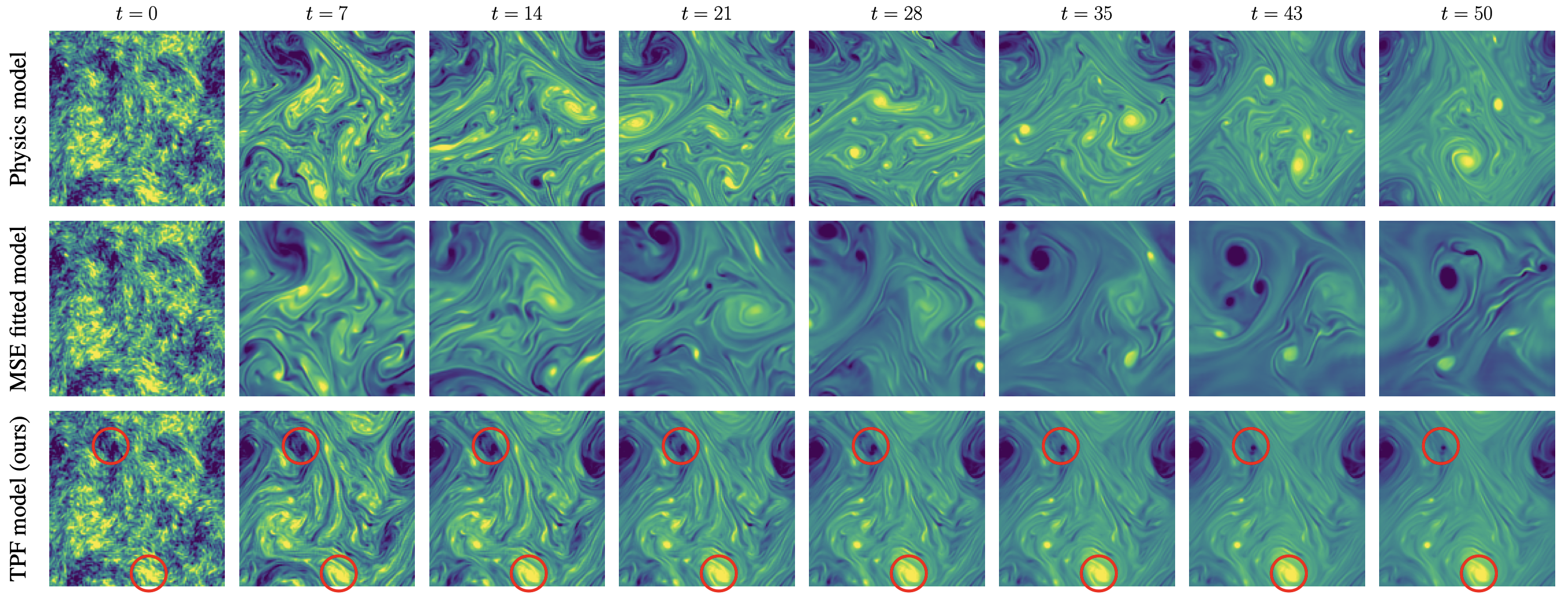
Barotropic turbulence with more than $10^4$ state dimensions. Top: ground truth. Middle: samples from a two-parameter flow. Bottom: pointwise trajectory fitting.
Many velocity fields are compatible with the same population data. This gauge freedom lets us pick fields by a criterion of our choice, such as minimal kinetic energy. Population dynamics offer the potential for a massive complecity reduction in the learned field, if one is willing to give up the goal of following sample trajectories.
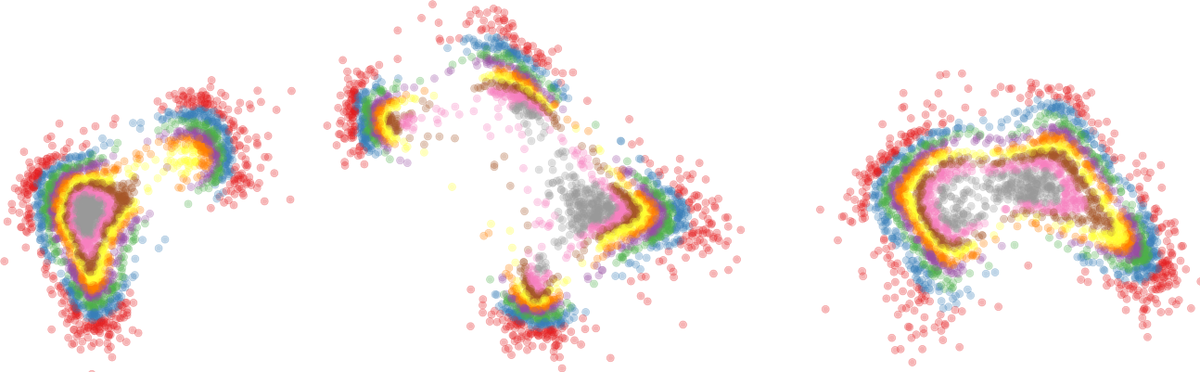
Snapshots of a curve $t \mapsto \rho_t$. Samples keep their color over time; the learned flow is similar to piecewise optimal transport, but more regular.
Papers
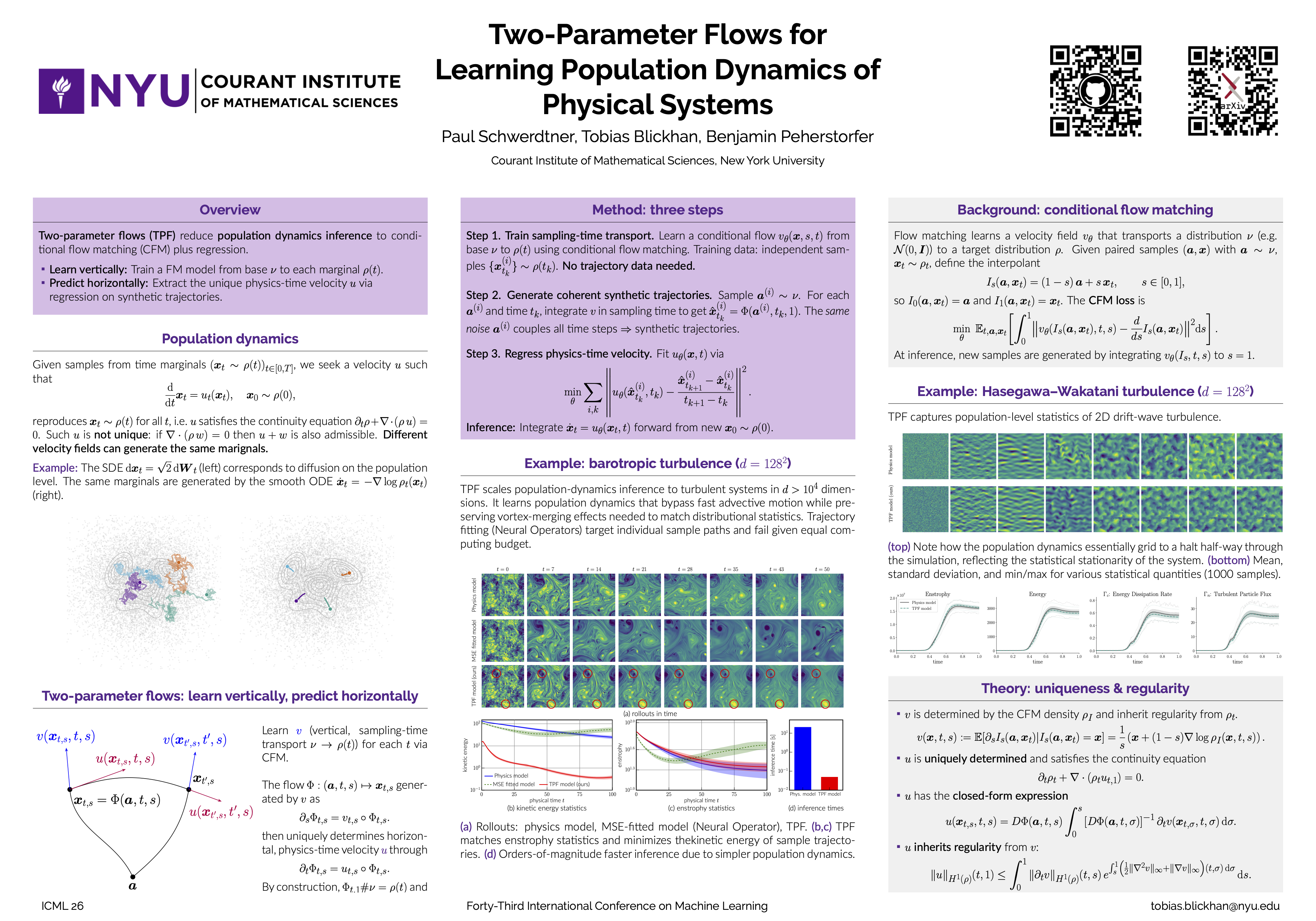
Two-Parameter Flows for Learning Population Dynamics of Physical Systems
Paul Schwerdtner, Tobias Blickhan, Benjamin Peherstorfer
ICML 2026
| 📄 OpenReview | 📄 arXiv | 📊 Poster | 💻 Code |
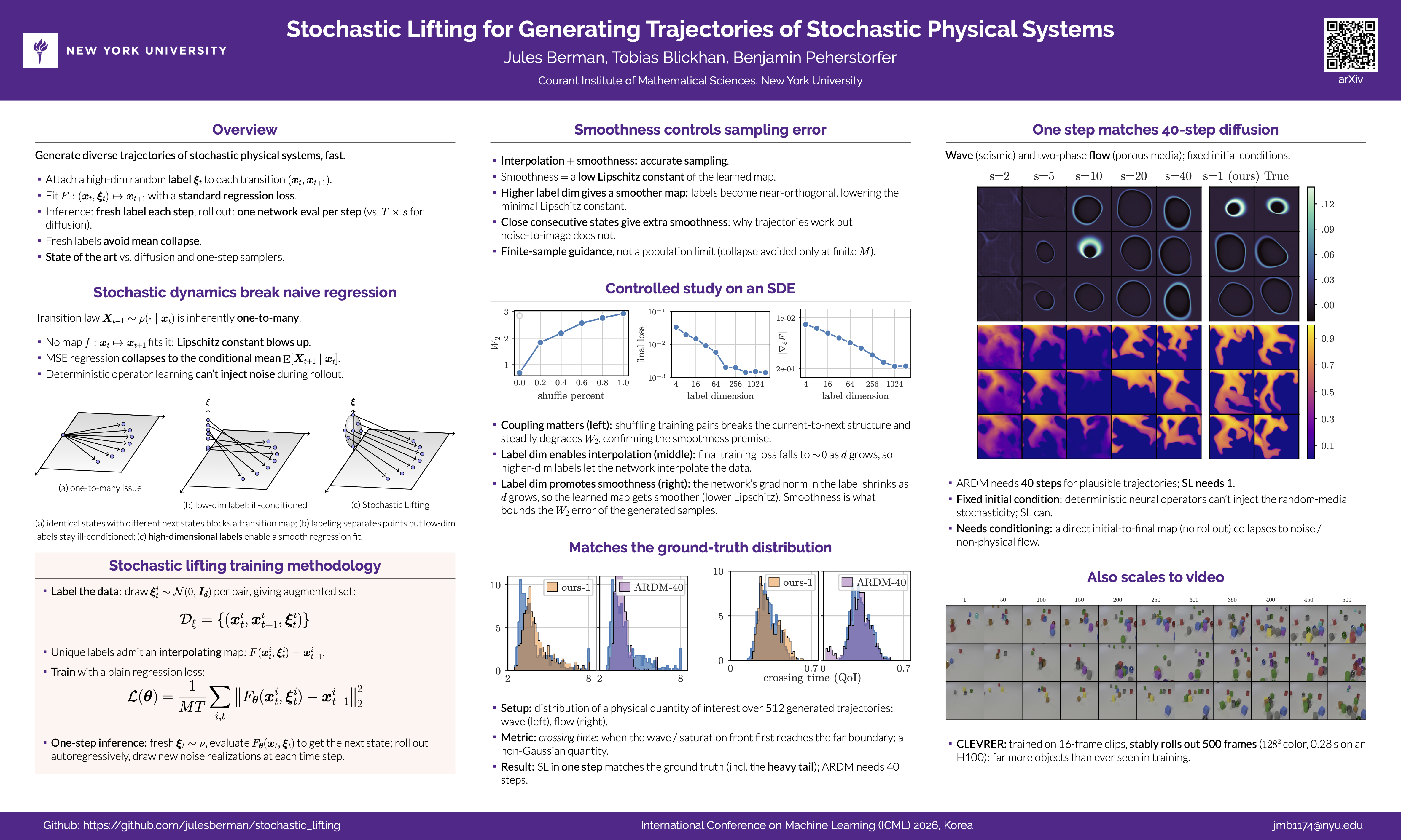
Stochastic Lifting for Generating Trajectories of Stochastic Physical Systems
Jules Berman, Tobias Blickhan, Benjamin Peherstorfer
ICML 2026
| 📄 OpenReview | 📄 arXiv | 📊 Poster | 💻 Code |
Leveraging Gauge Freedom for Learning Non-Gradient Population Dynamics of Stochastic Systems
Jules Berman, Tobias Blickhan, Benjamin Peherstorfer
arXiv preprint, 2026
| 📄 arXiv | 💻 Code |
DICE: Discrete Inverse Continuity Equation for Learning Population Dynamics
Tobias Blickhan, Jules Berman, Andrew Stuart, Benjamin Peherstorfer
Submitted to Journal of Machine Learning Research
Parametric Model Reduction of Mean-Field and Stochastic Systems via Higher-Order Action Matching
Tobias Blickhan, Jules Berman, Benjamin Peherstorfer
NeurIPS 2024
| 📄 Paper | 📄 arXiv | 📊 Poster | 💻 Code |
Acknowledgements
This work was supported by the National Science Foundation and the Air Force Office of Scientific Research.