
Population Dynamics Inference
| 📄 DICE on arXiv | 📄 NeurIPS 2024 Paper | 💻 Code |
Stochastic dynamical systems present notorious challenges for model order reduction. We propose a change of perspective: instead of inferring governing dynamics of a single system $X_t$, we consider the evolution of a population of such systems—the distribution of states over many realizations: $X_t \sim \rho_t$.
This distribution evolves according to a deterministic equation: $\partial_t \rho(t) = \text{div}(\rho_t u_t)$, where $u_t$ is a velocity field.
The task is to infer the velocity field $u_t$ that governs this evolution.
Different trajectory dynamics can give rise to the same population dynamics. This means there are infinitely many velocity fields $u_t$ that are compatible with observed data. We exploit this gauge freedom to find velocity fields that minimize kinetic energy or other selection criteria.
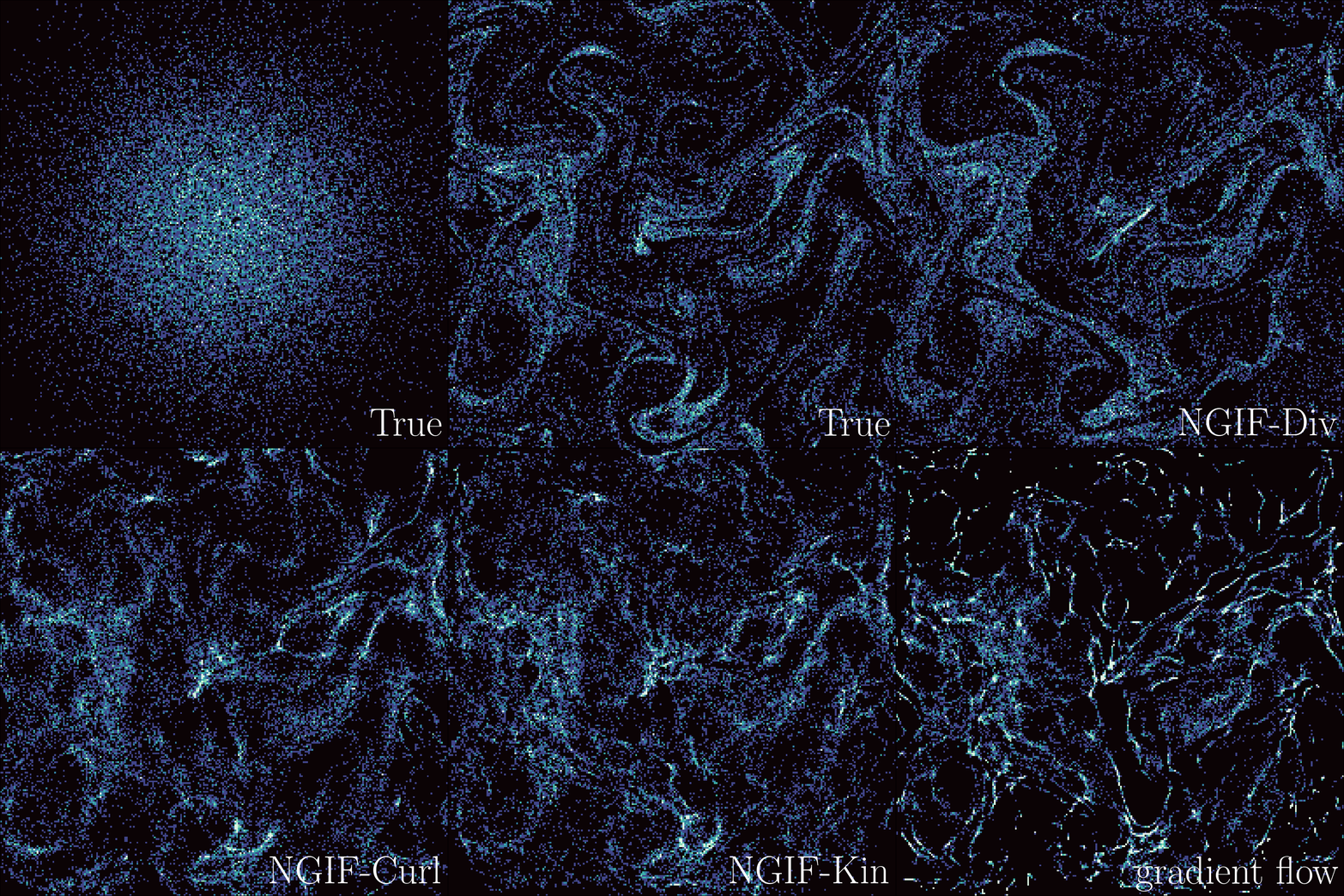
This work is related to generative modeling algorithms like score-based diffusion models and stochastic interpolants. In generative modeling, only the beginning and end of the path $t \mapsto \rho_t$ are given. Our framework provides a more constrained setting where generated samples collectively adhere to a physically meaningful path.
Papers
DICE: Discrete Inverse Continuity Equation for Learning Population Dynamics
Tobias Blickhan, Jules Berman, Andrew Stuart, Benjamin Peherstorfer
Previous approaches (e.g., Action Matching) have proven numerically unstable. We identify the root cause: a reliance on analytical properties that do not hold at the discrete level.
Parametric Model Reduction of Mean-Field and Stochastic Systems via Higher-Order Action Matching
Tobias Blickhan, Jules Berman, Benjamin Peherstorfer
NeurIPS 2024
| 📄 Paper | 📄 arXiv | 📊 Poster |
We present a method for parametric model reduction of mean-field and stochastic systems. Our higher-order formulation significantly improves numerical stability compared to previous action matching approaches.
Acknowledgements
This work was supported by the National Science Foundation and the Air Force Office of Scientific Research.